Italy Part Eight - Da Vinci and Basilicas of the City - Florence

Updated: Jul 21
During the night, I’m quick to learn that while the L'O in Firenze may have the highest ceilings I have ever seen, both them and the walls are paper-thin. I could hear everything happening outside my door with my neighbors and with the tenants above me, with little to muffle the sound. There were times this woke me up in the night, but I learnt to ignore it after a while.
We have the option for a late breakfast compared to our other days; however, with only one day in Florence, we decide to get up early and suffer for the sake of sightseeing. Being an early morning showerer, I get up and head into the bathroom. There is no tub at this hotel, only a metal shower head and nozzle behind glass. Unfortunately, I couldn't figure out how to turn the overhead shower on. There existed a button on the heat lever, but pressing it did nothing, and there were no other indications inside. With only one option, I did the entirety of my cleaning with the detachable nozzle. Not ideal, but it worked. My wife later informed me that she found the button actually needed to be pulled out, but by that point, it was too late.
With my shower finished and hair braided, I head down to enjoy breakfast. The food was beyond delicious, though the floor was pretty cramped, and you had to dodge other guests to get anything. That being said, it's still so tasty.

I had hoped to see the Birth of Venus today in the Uffizi Gallery; unfortunately, it's closed every Monday. If I had known, I would have seen it yesterday. While I'm not unhappy to see another basilica, at this point, there seems to be a new basilica every twenty feet, and the Gallery had promised to be a welcome change of pace. Oh well. I try to conceal my disappointment as we continue on the day.
We decide to see the Basilica Santa Maria Novella, which has the most stained glass out of any of the basilicas I’ve seen thus far. Though notably, almost all of them are missing faces. The most notable thing about this beautiful building is that it was the first great Basilica to be built in Florence. Though over the years, it has received a fair share of updates and changes as it progressed with the history of humanity.
Prior to the beautiful Gothic church that stands today, the 9th-century church Santa Maria delle Vigne (or St. Mary of the Vineyards) stood in its place in the fields just outside Florence’s Medieval walls. However, after the site was possessed by the Dominican Friars in the late 12th, early 13th century, they began to rebuild the site, renaming the church the Basilica Santa Maria Novella (or Basilica of the New Saint Mary).
The church was initially built with an East-West orientation as was dictated by tradition. However, over time, with the popularity of the sermons by Pietro da Verona, a former Cathar, a new area was given to the church to support the increased population of listeners. This caused the Basilica Santa Maria Novella modifications in the 12th, early 13th century to re-orient the church facing north-south to account for the increased space.
Traveling through the church, it’s easy to see the time periods Medieval, Gothic, and Renaissance reflected in the architecture. Over the centuries, sponsoring a chapel grew popular to show your great prestige, and so the Basilica Santa Maria Novella soon became filled with art, and its ordinary windows were replaced with beautiful stained glass. This is also when the front of the church (also known as the facade) was redesigned with the inscription “Giovanni Rucellai. Son of Paolo. Year of Salvation. 1470”. With this new re-design, we can see evidence of the Renaissance shown through the building’s perfect symmetry.
Though, with closer inspection, its Gothic and Medieval origins become more plain. Nearly all of the archways inside (and many outside) come to a point, supporting the high vaulted ceilings with pillars that give the illusion that the Basilica is longer than it actually is. Though the main altar inside is painted with frescoes, a style of art derived from the Renaissance period.


Over the years, this church has gained historical significance for its many evolutions and became a favorite of popes when it was used as the first council site to reunite the Orthodox and Catholic Churches in 1439. However, it was also famously used as one of Leonardo’s workshops for the Battle of Anghiari plans. In modern day, with its many artistic donations, it functions as a Basilica Museum, holding many pieces of artwork throughout the ages. Uniquely, this beautiful Basilica also has a section named “The Cloister of the Dead”, used as a cemetery for Dominican friars since the 13th century. Much like the church, this is the oldest cloister in Florence. Upon exiting, I’m shocked that while the front of the church was remodeled, looking at this basilica from the back, you would struggle to think it is the same building. This is because the back was never remodeled, retaining its original Gothic design.


As we travel on through the streets of Florence, we make our way to the Basilica di Santa Croce (Basilica of the Holy Cross), built around 1295. Not only is this church the largest Franciscan church in the world, but in the 16th century, it became famous for its pantheon of tombs. These tombs hold some of the most notable figures of time, such as Galileo Galilei, Michelangelo, Niccolo Machiavelli, and Gioachino Rossini. Standing tall outside the church is a giant statue of Dante Alighieri, the writer of Dante’s Inferno and the Divine Comedy, while inside, he holds an honorary tomb despite the fact that his body is held in the Basilica of Saint Francis.


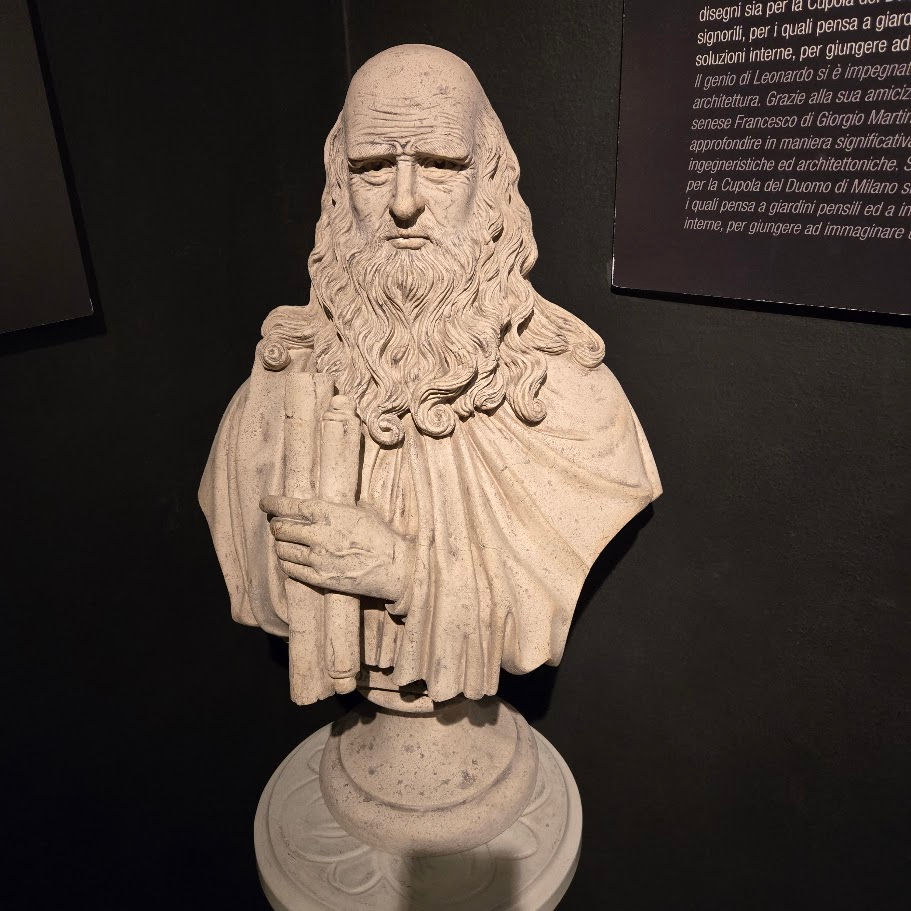
By this point, the family has decided to split up and see various attractions, shop, or rest. By pure chance, we stumbled upon the Leonardo Interactive Museum, which is cleverly tucked away between buildings. Inside are several re-created inventions from the famed painter, some of which make sense for their purpose, while others leave much to be desired.
Leonardo was primarily known as a painter, despite creating and designing several inventions that we have improved upon today. This is because while many of his inventions did not last past his lifetime, his notebooks were tucked away for private viewing by rich nobles who studied them with fascination. However, these notebooks came to public light slowly, beginning in the 17th century until the last were revealed in the 19th century. Within these pages is a record of his vast accomplishments, both intellectual and technical, with thousands of references that we still use today to study the great inventive mind of Leonardo Da Vinci.
During his lifetime, Da Vinci was very invested in the expansion of military technology. Despite his vast respect for the natural world, living in the age of the Renaissance meant that working as a military engineer not only kept him employed but also allowed him unique travel opportunities to continue his scientific work without question. This is where many of his sketches and inventions begin, theorizing plans for giant crossbows, tanks, submarines, and suba diving suits.


One of his sketches brought to life was titled the scythed chariot, functioning with two horses pulling a giant spinning blade. Immediately, this idea seems unrealistic, as it seems not only difficult to steer, but also rather impractical for use as a killing machine. Any intended victims would first need to bypass the horses without harming them in the process if the machine is to do its intended damage.


Through this fascination with war, Da Vinci fell in love with the idea of flight, which quickly turned into an obsession. Though he was never able to successfully achieve long-lasting flight, this did not stop him from creating over five hundred sketches detailing various flying machines. To further his attempts at flight, in 1505, he created a codex titled “Codice sul volo degli uccelli” (Codex on the Flight of Birds), studying how birds were able to achieve such an accomplishment in an effort to mimic their skills with similar results.
Unfortunately, the results of his observations did not find success during Da Vinci’s lifetime due to his inability to abandon the idea of flapping wings. However, the observations recorded in the Codex on the Flight of Birds, such as center of gravity, lifting pressure, wings and tail shape, and aerodynamic designs, helped move along the development of a successful airplane in the early 20th century by the Wright brothers. The idea of man taking flight, however practical and realistic it may be today, all began with Da Vinci and his imaginative mind, which sparked the idea of possibility in future generations.


With the day coming to an end, we grab our bags and hop onto the train to Venice. It's a bit too dark to see anything out the window this evening, but I do notice that the trees get bigger the longer we ride as we travel north. Once we arrive in Venice, we take a beautiful moonlight boat ride to our hotel, Antico Doge. After we set out things down, we get a quick bite of calamari to eat, before returning. The beds are as hard as rocks at this hotel, but my exhaustion doesn't seem to care as I pass out almost instantly.


Works Cited
Basilica of Santa Maria Novella
Battista, Rossella. Discovering the Basilica of Santa Maria Novella, Firenze, 10 May 2021, www.firenzemadeintuscany.com/en/article/discovering-the-basilica-of-santa-maria-novella/.
Battista, Rossella. Basilica di Santa Maria Novella: history and curiosities of one of the most important churches in Florence, Firenze, 10 May 2021, www.firenzemadeintuscany.com/en/article/basilica-of-santa-maria-novella-history-curiosities/.
Flores, Lourdes. Santa Maria Novella & Museum, visitflorence.com, 23 May 2002, www.visitflorence.com/florence-churches/santa-maria-novella.html.
LaChiusa, Chuck. Exterior - Basilica of Santa Maria Novella, Architecture Around the World, 2020, buffaloah.com/a/virtual/italy/flor/nov/.
Tribe, Shawn. Santa Maria Novella - The Dominican Church of Florence, Liturgical Arts Journal, 29 Mar. 2024, www.liturgicalartsjournal.com/2024/03/santa-maria-novella-dominican-church-of.html.
Santa Croce
Santa Croce, Italy Museum, www.florence-museum.com/santa-croce-holy-cross.php.
Stamper, Peta. Basilica di Santa Croce, History Hit, 13 July 2021, www.historyhit.com/locations/basilica-di-santa-croce/.
Leonardo da Vinci Finnan, Vincent. Leonardo Da Vinci Weapons of War, Italian Renaissance Art, 5 Feb. 2008, www.italian-renaissance-art.com/Da-Vinci-weapons.html.
Jakab, Peter. Leonardo da Vinci and Flight, National Air and Space Museum, 22 Aug. 2013, airandspace.si.edu/stories/editorial/leonardo-da-vinci-and-flight.
Leonardo da Vinci's notebooks, Victoria and Albert Museum, www.vam.ac.uk/articles/leonardo-da-vincis-notebooks?srsltid=AfmBOopo5TAClMZGmLdiIkbp7hlk61oqnOsY9YdMfTV_7PnOIxr6V44J.
Leonardo Interactive Museum, leonardointeractivemuseum.com/en/.


Comments